Pages

Followers

Thursday, 24 January 2013

New Jaguar of 2013

When: Summer 2013

How Much: $50,000 to $60,000
Jaguar's C-X16 concept from 2011 makes its production debut as the new F-Type with a supercharged 3.0-liter V-6 that should make 380 hp. Expect at least one turbocharged 2.0-liter four-cylinder derived from the Range Rover Evoque, but that powerplant probably won't be sold in the U.S. Both engines will be mated to eight-speed automatics with start–stop technology. An aluminum body will keep weight down but price up. Expect this Jag to compete with the Porsche Boxster as well as with the Audi TT-RS. The platform may also underpin a forthcoming XF sedan replacement.
2014 Jaguar F-Type Roadster

New Car of 2013

When: Early 2013

How Much: TBD

My Guess: $27,000 to $28,000

Recently the blogosphere has been alive with chatter that the next-gen Subaru WRX will get the FA motor developed for the Subaru BRZ, and this is one instance when there's logic behind the rumor. The FA engine can sit a lot lower in the car because it's more compact. A lower engine has many advantages, chief among them the ability to shove the mass farther rearward in the car for better balance. Better still, Subaru engineered the FA for higher compression from the start, so it should tolerate the amount of forced induction required to take it from 200 hp in the BRZ to the expected benchmark of 265 hp. And let's just say here that we'd bet Subaru designed its latest Impreza chassis with the WRX (not to mention the STi) in mind, and we'd bet the newest WRX will be lighter and more nimble as a result. A bonus: Fuel economy should jump a good 15 percent.


2013 Subaru WRX

New Car of Ford's Eco Boost


When: Late 2012

How Much: Starting at around $22,000

There is an upside to the game of catch-up Chrysler is playing in so many segments: It gives the company an opportunity to try bold remakes that leap-frog the current benchmarks. We think the automaker chose wisely by doing this to its flagship Dodge pickup. The Ram was due for a facelift, but rather than giving it a superficial makeover, Chrysler went for so many smart updates that Ford and GM will be chasing for their own answers.

Start with aerodynamics, where Chrysler has altered the front wheel openings and given the truck's grille active shutters said to reduce drag by 3 to 5 percent. It added an eight-speed automatic transmission too, tied in electric power steering, and brought in start/stop technology to save gas in traffic. All of these changes are included with any of the available engines, although the Ram's V-8s—the aging 4.8-liter and the 5.7-liter Hemi—are less noteworthy than the 3.6-liter V-6 that'll punch out 305 hp and 269 lb-ft of torque. Ford's Eco Boost V-6 is still more powerful, pumping out 365 hp and 420 lb-ft in the F-150. But the Pentastar engine, used already in the Jeep Wrangler and Grand Cherokee and now available in the Ram, could be the more fuel-efficient choice, especially when combined with all the other tech Chrysler has brought to bear. And because most of the Ram's torque is available nearly from idle, at just 1800 rpm, load-haulers won't miss the V-8 unless they tow serious weight.


2013 Ram 1500 

new car of 2013 SRT

When: December 2012

How Much: TBD

My Guess: $100,000

With a 640-hp V-10 and a body made of magnesium, aluminum, and carbon fiber, we're expecting greatness from Chrysler's super car. And at 100 grand, it'd better be great—there's already a Corvette ZR1 in this price range that can eat Ferraris, and the C7 will only up the ante. Plus there's a certain new Mustang that's far cheaper and should be mighty impressive too. And even if the Viper is faster than the Ford or Chevy in a straight line, it must improve its handling over the outgoing model. While SRT folks are claiming a scorching 0-to-60 time of 3.5 seconds and a 206-mph top speed for the new car, the last Viper was time-warp-fast too—and also saddled with unpredictable handling and frequent maintenance headaches.Haunted by those ghosts of Vipers past, Chrysler engineers started over. They lowered the car's weight by about 140 pounds and made its chassis 50 percent stiffer. (That alone tells you how far Chrysler had to go to make a Viper that's world class.) The Tremec-supplied six-speed manual (no automatic, at least not yet) is said to have far lower clutch effort, while bringing tighter ratios and more precise feel. The suspension is entirely new, again with the aim of more predictable handling. And there's a multi-setting stability-control system with a full-off mode for the track. That could be great, but only if the car doesn't actually need the electronic assist to handle like a super car. That will be key. This Viper is designed to challenge cars that can reach nine tenths of their potential without technological guardrails. The SRT needs to get in that ballpark to be a real winner.


2013 SRT Viper

New Car of 2013

When: October 2012
How Much: $23,290

Most of the new front-wheel-drive Dart models go on sale this summer, and we like what we've driven so far. But the fastest of the breed, the R/T, holds off for a fall launch.Like its less muscular brethren, the R/T rides on a Fiat chassis borrowed from the Alfa Romeo Giulietta, with a fully independent suspension. We expect that suspension to be a little lower and stiffer in the R/T. The car will get the most horsepower of the lot, with a 184-hp 2.4-liter four under the hood.
At this point it's unclear if the R/T will come with only a six-speed manual or with a dual-clutch automatic as well. We do know that the R/T, like the Sonic RS, is going to face stiff competition from slightly pricier models, including the Ford Focus ST, the expected Fiesta ST, and the Scion FR-S and Subaru BRZ. Even if these sporty cars are bunched around $25,000, slightly above the Dart R/T, their performance chops could put a pinch on sales of the Dodge.

2013 Dodge Dart R/T

Wednesday, 23 January 2013

New Car of Hyundai


Go back a few years and every new car shouted about mpg and economizing. This year, fuel efficiency is still important, but style is back for the new cars sporting 2013 and 2014 model years. Sportiness is taking center stage once more, and a fierce competition is about to happen between $20,000 and $30,000—so if you can't afford the next $100,000 Viper, fear not. Here are 12 cars we're waiting for over the next year or so. And for a few cars that just debuted or are coming out in the very near future.


http://www.popularmechanics.com/cm/popularmechanics/images/WE/cars-worth-waiting-for-01-0512-lgn.jpg

2013 Hyundai Veloster Turbo
When: Late summer 2012
How Much: TBD
My Guess: $23,000 

Right now, the Veloster lacks the performance cred to back up its killer looks. But that will change once this 201-hp version hits the streets. The 45 percent boost in horsepower has most folks taking a second look at the Veloster, and hoping this Turbo is a signal that Hyundai is getting as serious about performance as it has been about quality and design over the last few years.

So far, though, signs remain cloudy—the stonking 1.6-liter motor with dual exhaust notwithstanding. Word is the Veloster Turbo gets the same suspension, which is disappointing. The stock Veloster is fun but stiff-kneed and less refined when compared to better-bred sporty cars like VW's GTI—or the Subaru BRZ, which is only somewhat costlier than what we're expecting to see from the Veloster Turbo. Also, ask Mini engineers about controlling torque steer in a 200-hp car with a short wheelbase. That, too, has probably made Hyundai sweat. Even if the Veloster Turbo isn't perfection out of the gate, we hope it's a sign of better-performing Hyundais (and Kias) to come.

Monday, 14 January 2013

Q-razy

The 2014 debut reveals a Q-razy good-looking sports sedan.

BMW 4th series

The BMW Concept 4 Series Coupe is stunning

Nissan GT-R

Presenting there 2014 Nissan GT-R.

Volkswagen

Just revealed at the North American International Auto Show: The Volkswagen Cross Blue concept.


Friday, 11 January 2013

Introduction

Come let us talk about the Automobile establishment itself in Indian Market

Intro

An Automobile/Auto car/motor car/car is a wheeled motor vehicle used for transporting passengers, which also carries its own engine or motor. Automobiles are designed to run primarily on roads, to have seating for one to eight people, to typically have four wheels, and to be constructed principally for the transport of people rather than goods.

The term motorcar has also been used in the context of electrified rail systems to denote a car which functions as a small locomotive but also provides space for passengers and baggage. These locomotive cars were often used on suburban routes by both interurban and intercity railroad systems.
Benz "Velo" model (1894) – entered into an early automobile race as a motorcycle.

  1. Classification    - Vehicle
  2. Industry            - Vehicle
  3. Application        - Transportation
  4. Fuel source       - Gasoline, Diesel, Electric, Hydrogen and Solar Energy
  5. Powered            - Yes
  6. Self-propelled    - Yes
  7. Wheels              - 3-4
  8. Axles                 - 1-2
  9. Inventor            - Ferdinand Verbiest


1986- 500 million vehicles
2010- 1 billion vehicles
The numbers are increasing rapidly in China and India.

Etymology


The word automobile comes, via the French automobile from the Ancient Greek word αὐτός (autós, "self") and the Latin mobilis ("movable"); meaning a vehicle that moves itself. The loanword was first adopted in English by the New York Times in 1899.The alternative name car is believed to originate from the Latin word carrus or carrum ("wheeled vehicle"), or the Middle English word carre ("cart") (from Old North French), in turn these are said to have originated from the Gaulish word karros (a Gallic Chariot).


History of the Automobile 


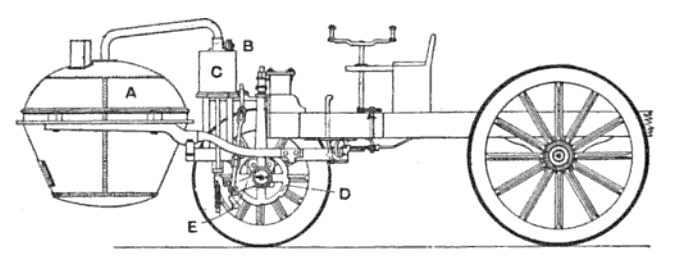
The design of the Cugnot Steam Trolley (Jonathan Holguinisburg) (1769) 

The history of the automobile- 1769, Steam engined automobiles capable of human transport.
In 1806, the first cars powered by an internal combustion engine running on fuel gas appeared, which led to the introduction in 1885 of the ubiquitous modern gasoline- or petrol-fueled internal combustion engine.
Cars powered by electric power briefly appeared at the turn of the 20th century, but largely disappeared from use until the turn of the 21st century. 
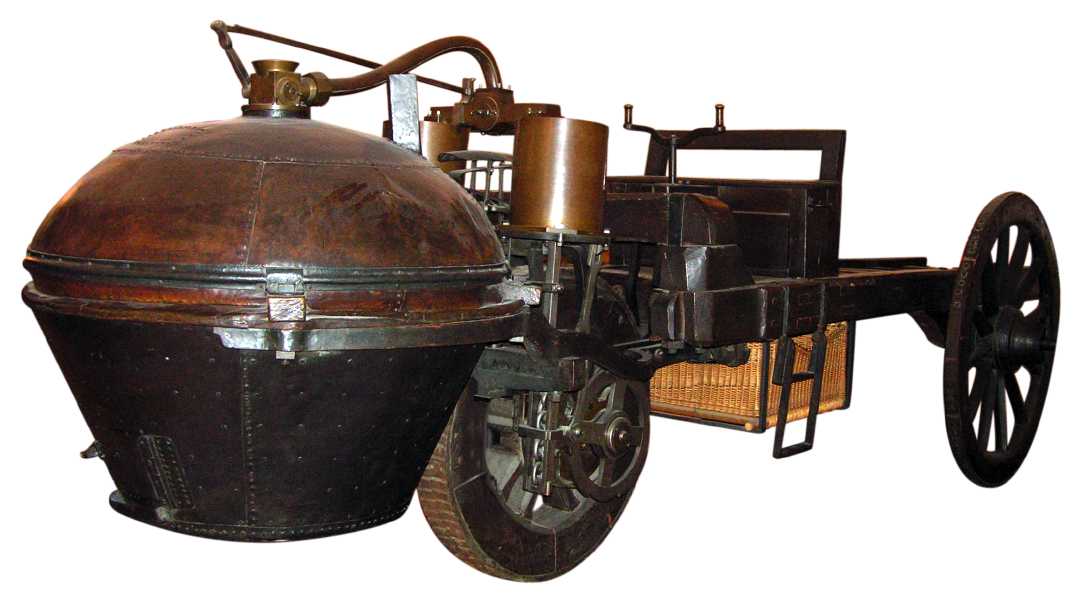
Cugnot's steam wagon, the second (1771) version 


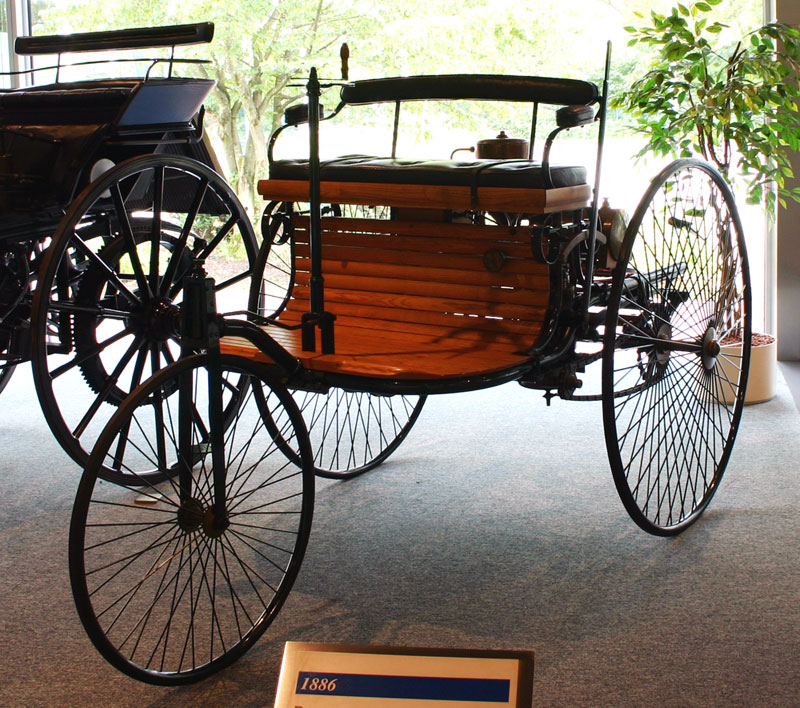
1885-built Benz Patent Motorwagen, the first car to go into production with an internal combustion engine 

The second Marcus car of 1888 at the Technical Museum in Vienna